Most homeowners start the pool conversation the same way. They search, they get quotes, and somewhere between the first call and the third brochure, someone asks: fibreglass or concrete?
It's the central question of any NZ pool project, and it's worth answering clearly. Fibreglass swimming pools have become the preferred choice for New Zealand homeowners - not because of clever marketing, but because of what happens over years of ownership. Lower running costs. Less time spent on maintenance. A pool that still looks great a decade in, without a costly resurface.
This guide walks through the comparison honestly, so you can make the right call for your home and your budget.
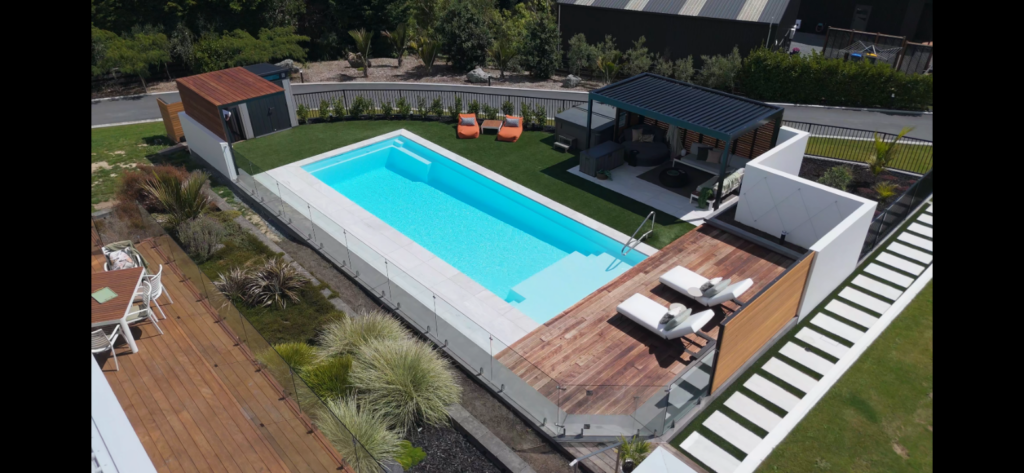
A fibreglass pool is a factory-manufactured shell, moulded from fibreglass-reinforced plastic and finished with a gelcoat interior. The shell is made in a single piece, delivered to site, and installed into a prepared excavation, typically within one week. The gelcoat surface is non-porous, smooth, and colour-integral, meaning the colour runs through the coating rather than sitting on top.
Inground fibreglass pools come in a wide range of shapes, sizes, and depths, from compact plunge pools to full family-size models with ledge seating and shallow entry areas.
This is the comparison most New Zealand homeowners need, so here it is side by side.
| Fibreglass | Concrete | |
| Installation time | 1 week | 3–6 months |
| Surface | Smooth, non-porous gelcoat | Rough, porous plaster or aggregate |
| Chemical use | Lower (algae struggles to take hold) | Higher (porous surface harbours algae) |
| Annual maintenance cost | Lower | Higher |
| Resurfacing | Not required in normal lifespan | Every 10–15 years ($15,000–$30,000+) |
| Flexibility (ground movement) | Flexes without cracking | Can crack with soil movement |
| Custom shape options | Manufacturer range | Fully custom |
| Lifespan | 25+ years | 25+ years (with maintenance) |
| UV performance | Gelcoat colour holds well | Surface degrades and fades |
Concrete pools offer one genuine advantage: complete customisation. If you need an unusual shape or a very large pool that doesn't fit any standard mould, concrete gives you that freedom. For most New Zealand homeowners, though, the available fibreglass range covers every practical need and the ongoing savings are significant.
One of the most underestimated differences between fibreglass and concrete pools is time.
A fibreglass shell is manufactured to specification in a controlled factory environment. When it arrives on site, the excavation is prepared, the shell is craned in, connections are made, and the pool is filled. Most installations are complete in one to three weeks.
Concrete is built on-site. The process involves excavation, steel reinforcing, spraying or pouring concrete, curing time, plastering, and finishing. From start to swim, you're typically looking at three to six months.
That time difference matters practically. It means less disruption to your backyard, fewer weeks of access restrictions, and a faster path to actually using what you've paid for. For families who start planning in autumn with summer in mind, it can mean the difference between swimming and waiting another year.
The non-porous surface of a fibreglass pool is the key to lower running costs. Algae needs something to grip onto. On a smooth gelcoat interior, it struggles. On a porous concrete surface, it finds plenty of places to grow.
The result is a meaningful difference in what you spend on chemicals each year. Fibreglass pool owners typically use 70% less chlorine than concrete pool owners. Over a ten-year period, that adds up to thousands of dollars.
The bigger saving comes from what fibreglass doesn't need. Concrete pools require resurfacing every ten to fifteen years. In New Zealand, that work typically costs between $15,000 and $30,000 depending on the pool size and the finish chosen. It's a significant cost that fibreglass owners don't face.
Low maintenance pools in New Zealand also need to account for UV exposure. New Zealand has some of the highest UV levels in the world, and that affects pool surfaces. Concrete plaster and aggregate finishes fade and degrade under sustained UV. Fibreglass gelcoat holds its colour better over time because the colour is part of the coating itself, not a layer applied on top.
Durable swimming pools for New Zealand need to handle more than UV. Ground movement is a real consideration, particularly in Wellington and other areas of seismic activity.
Concrete is a rigid material. When soil shifts, a concrete pool can crack. Fibreglass is flexible by nature. The material can accommodate minor ground movement without structural damage, which makes it a particularly good fit for Wellington sections where the ground has some give.
The fibreglass shell also doesn't corrode. There are no steel reinforcing elements close to the pool surface, so you don't get the rust staining that can affect concrete pools over time.
When it comes to durability, fibreglass doesn't ask much. A regular water balance, occasional brushing, and an annual check of your filtration system covers most of what the pool needs. There's no plastering to inspect, no surface to reseal, and no concern about the interior breaking down as the years go by.
The range of inground fibreglass pools available in New Zealand has expanded considerably in recent years. The idea that you're limited to a basic rectangle is well out of date.
NZ Pools stocks the Leisure Pools Australia range, which includes models from compact entry-level designs through to large family pools with multiple features. Current models span eleven styles, including the Reflection, Elegance, Absolute, Acclaim, Harmony, Esprit, Olympus, Capri, Fiji Plunge, and the Reflection variants with Auto Cover or Splash Deck. All models are available across a wide range of sizes and in eight interior colours: Sapphire Blue, Crystal Blue, Diamond Sand, Aquamarine, Shimmer White, Graphite Grey, Silver Grey, and Ebony Blue.
Key features available across the range include:
Every pool in the range is manufactured to Australian and New Zealand standards. NZ Pools handles the full process from initial consultation through to installation and aftercare, so you're not managing multiple contractors across a six-month build.
The upfront cost of a fibreglass pool is generally comparable to a concrete pool of similar size. Where fibreglass pulls ahead is in total cost of ownership.
Add up the chemical savings over ten years. Add the cost of a concrete resurface you'll never need. Factor in the time cost of higher maintenance. The picture becomes clear: fibreglass is the more cost-effective choice for most New Zealand homeowners over any reasonable timeframe.
This is why fibreglass swimming pools in New Zealand have grown in popularity even as the overall pool market has become more competitive. Homeowners who've done the maths choose fibreglass not because it's cheaper to buy, but because it's cheaper to own.
If you're serious about understanding the numbers for your specific situation, a conversation with the NZ Pools team is the fastest way to get there. They can walk you through what your ongoing running costs are likely to look like based on pool size, your location, and how often you plan to use it.
Request a free quote from NZ Pools
Wellington has particular reasons to favour fibreglass.
The city's weather is more variable than Auckland or Nelson, but Wellington summers are genuinely warm, and a heated fibreglass pool extends the usable season from October through to April. The shorter installation window matters when weather windows are narrower.
Wellington sections often sit on ground with some movement. The flexibility of fibreglass is an asset here, where rigid concrete would carry more risk.
And Wellington's strong UV exposure during summer months makes the UV-resistance of fibreglass gelcoat a practical benefit, not just a marketing point.
NZ Pools is the only SPASA Gold Award-winning pool installer in Wellington (Fibreglass Pool up to $80,000, 2024). The team has been installing pools across Wellington and Wairarapa for years, and their knowledge of local sections, local councils, and local conditions is part of what makes the process straightforward.
Are fibreglass pools better than concrete pools? For most New Zealand homeowners, yes. Fibreglass pools install faster, cost less to maintain, don't require resurfacing, and are more resistant to cracking from ground movement. Concrete pools offer more shape flexibility, but the practical advantages of fibreglass outweigh this for the majority of residential installations.
How long do fibreglass pools last in New Zealand? A well-maintained fibreglass pool can last 25 years or more. The gelcoat surface is durable and UV-resistant, and the shell itself is not subject to corrosion. The key is maintaining good water chemistry, which protects both the shell and the pool equipment.
What is the maintenance cost of a fibreglass pool in NZ? Fibreglass pools use significantly fewer chemicals than concrete pools, typically around 70% less chlorine. Combined with no resurfacing requirements, annual maintenance costs are considerably lower. Exact costs depend on pool size, usage, and your chosen maintenance approach (self-managed vs professional servicing).
How long does it take to install a fibreglass pool? Most fibreglass pool installations take one to three weeks from excavation to fill. This compares favourably to concrete pools, which typically take three to six months to build on-site.
Can fibreglass pools crack? Fibreglass is a flexible material that can accommodate minor ground movement without cracking. This makes it particularly suited to areas with some seismic activity, such as Wellington. Concrete pools, being rigid, carry a higher risk of cracking when soil shifts.
What colours are available for fibreglass pools in NZ? The Leisure Pools range available through NZ Pools comes in four interior colours: Graphite Grey, Shimmer White, Sapphire Blue, and Ebony Blue. The colour is part of the gelcoat itself, so it holds well over time without fading.
If you're weighing up your options, the best next step is a conversation with someone who knows Wellington sections, local councils, and the full range of available pools.
The NZ Pools team offers free consultations with no obligation. They'll help you understand what pool would suit your section, what the installation process involves, and what your ongoing running costs are likely to look like.
Browse the pool range at nzpools.co.nz and get in touch to request your free quote.