A swimming pool is one of the biggest backyard investments most families ever make, and a good one should last 25 years or more. The trouble is, your family won't look the same in 25 years. The toddler splashing in the shallows today is the teenager doing bombs off the side in five years, the young adult bringing flatmates round for summer barbecues a decade later, and eventually the parent watching the next generation jump in for the first time.
Family-friendly pool design is really about future-proofing. The best pool areas adapt to every stage of family life, not just the one you're in right now. Here's how to plan a backyard pool for families that still feels like the right choice in 10, 15, and 20 years.
A future-proof pool design accommodates different ages, swimming abilities, and uses without needing major modifications. The key elements are a thoughtful combination of depth zones, safe and easy entry points, a shape that supports both play and exercise, surrounds that work for supervision and entertaining, and low-maintenance materials that hold up to heavy use. Get those right at the design stage and your pool stays useful from the toddler years right through to grandchildren visiting on summer holidays.
Depth is the single most important decision you'll make for long-term usability. A pool that's too shallow is fine for small kids but dull for teenagers. A pool that's too deep makes parents nervous and excludes younger swimmers from large parts of the water. The sweet spot is a pool with a graduated depth profile, often called a sport pool or family pool layout.
A typical family-friendly depth runs from around 1.1 metres at the shallow end to 1.8 or 2.0 metres at the deeper end. That gives you:
Resist the temptation to design only for the kids you have right now. A 1.0 metre uniform-depth pool feels generous when you have a five-year-old. It feels cramped and shallow when that same child is 14, learning to swim freestyle, and wanting to invite friends over. The Leisure Pools sport-style models we install across Wellington and Wairarapa are specifically shaped to handle multiple uses at once.
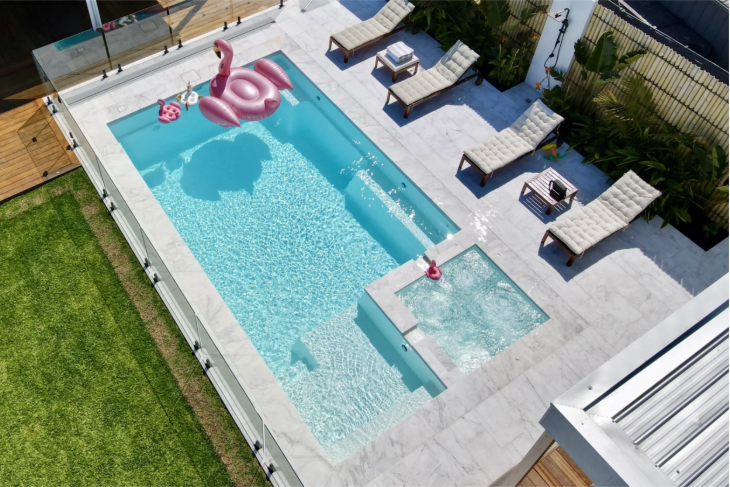
Pool shape affects what your family can actually do in the water. The right shape lets one person swim laps while another plays games, while a third lounges on a step.
Rectangular pools are the workhorses of family-friendly pool design. They make the best use of available space, support lap swimming, and create clear zones for play and rest. The Leisure Pools Reflection and Elegance ranges are good examples.
Plunge pools are compact, often designed for smaller sections, and work well in courtyard settings. They suit families who entertain more than they exercise and have limited backyard space, which is common in inner-Wellington properties.
If you're not sure which suits your family, think about how you'll use the pool five and ten years from now, not just this summer. A growing family typically gets more value from a rectangular or modified-rectangular shape with built-in seating ledges.
Getting in and out of the pool is where small kids, older parents, and tired teenagers all meet. A well-designed entry zone matters as much as the pool itself.
The features worth specifying at the design stage:
A beach entry is one of the best long-term investments you can make. It works as a paddling area for under-fives, a seating zone for adults, a place to set up a sun lounger half-in the water, and eventually a safe access point for ageing parents who want to stay involved without struggling on steep steps.
Different ages want different things from a pool. The clever part of family-friendly pool design is choosing features that serve multiple stages.
For the under-fives: A shallow tanning ledge, a fenced area, soft surrounds, and warm water (a heating system pays off here). At this stage you want supervision to be easy and the space to feel safe.
For school-aged kids: Room to play games, learn to swim properly, and invite friends over. Pool toys, basketball hoops, and floating mats become daily features. You want enough open water for activity and clear sightlines for the parent on duty.
For teenagers: Deeper water for jumping, room for groups, and somewhere to socialise without parents looming. Built-in lounging ledges and a separate seating zone outside the pool help here. LED pool lighting suddenly matters for evening swims.
For young adults and visiting friends: A pool that doubles as an entertaining feature. Decking, shade, and outdoor furniture become as important as the pool itself.
For empty-nesters and grandparents: Easy access, lower-maintenance equipment, and water-based exercise. Stairs, handrails, and warm water start to matter more again, often coming full circle.
The same pool can serve all these stages if you plan for it. The feature you skip now to save a few thousand dollars is often the one you wish you'd installed when your kids hit 12.
The pool itself is only part of the family-friendly design. The space around the pool determines whether it actually gets used.
Decking and paving need to be slip-resistant when wet, comfortable underfoot, and durable enough for years of bare feet, wet towels, and outdoor furniture. Composite decking and exposed-aggregate concrete both perform well in New Zealand conditions.
Shade matters more than people realise. A pool baking in full Wellington sun all day might sound great in theory, but in practice you'll want a covered area where the kids can take a break, where snacks can be served, and where adults can supervise without burning. Pergolas, sail shades, and planted trees all work. Just plan their position relative to the pool early.
Lawn space near the pool gives you somewhere to set up a paddling pool for a tiny one, throw a frisbee for the dog, or pitch a tent for a sleepover. Don't pave the entire backyard.
Storage is the unsung hero. A small lockable shed near the pool for floats, robotic cleaners, chemicals, and pool toys keeps the space tidy and stops you tripping over inflatables for the next decade.
A family pool is rarely just a family pool. Birthday parties, summer barbecues, Christmas gatherings, and Friday afternoon catch-ups all end up centred on the water once you have one.
Adaptable pool ideas for entertaining include:
Designing the entertaining zone alongside the pool, rather than retrofitting it later, saves money and produces a much better-integrated result.
Family life is busy. The years when you most want a pool are also the years when you have the least time to look after one. Low-maintenance design choices pay dividends for decades.
The goal is a pool that takes 10 to 15 minutes a week of attention during peak season. That's achievable with a well-designed fibreglass pool and modern equipment.
In New Zealand, pool fencing is a legal requirement under the Building Act 2004 (which absorbed the original Fencing of Swimming Pools Act 1987). Any pool capable of holding water more than 400 mm deep must have compliant safety fencing, with self-closing and self-latching gates, and the area must be inspected at least every three years by your local council.
For a family-friendly pool, fencing is also a peace-of-mind feature. Practical considerations:
The fence is the first and last line of defence. Every other safety feature builds on top of it.
Before you sign off on a design, run through this list:
Tick most of these off and your pool will still feel like the right pool when your kids are bringing their own families round for Christmas.
What's the ideal pool depth for a family with young children? A graduated depth from about 1.1 m to 1.8 m gives the best long-term flexibility. The shallower end is safe for younger swimmers, while the deeper end supports older kids learning to swim properly, jumping in, and playing games. Avoid uniform-depth pools shallower than 1.1 m if you want long-term value.
How big should a family pool be? For a family of four, a pool around 7 m to 9 m long and 3.5 m to 4.5 m wide is the typical sweet spot. It's big enough to swim, play, and entertain, while still fitting most Wellington-area sections. Smaller plunge pools work for tighter sites if compact entertaining is the priority.
Is fibreglass the best option for a family pool? Fibreglass is generally the best fit for families because of its lower maintenance, smoother surface (gentle on skin and feet), durability, and faster installation. The non-porous gel coat resists algae and means less time on upkeep, which matters when you're already juggling kids, work, and weekends.
How can I future-proof my pool design? Choose a graduated depth, a versatile rectangular or modified-rectangular shape, wide entry steps with a tanning ledge, internal seating, low-maintenance fibreglass construction, and a generous surround with shade and lawn nearby. Specify heating, lighting, and a cover at the design stage rather than as add-ons later.
Are saltwater pools better for kids? Many families prefer saltwater chlorination because the water feels softer and is gentler on skin, eyes, and swimwear. The salt level is far below seawater concentration. It's a popular choice for families with young children or anyone with sensitive skin.
How long does a fibreglass family pool last? A quality fibreglass pool with a Leisure Pools shell is designed to last a lifetime with proper care. The structural warranty on the shell is lifetime, and the gel-coat surface is rated for decades of use. That's why future-proofing the design matters: your pool will outlast plenty of life stages.
A family-friendly pool isn't about fitting today's family into a pool. It's about creating an outdoor space that grows alongside your family for the next two or three decades. The right size, shape, depth profile, entry points, and surrounds, combined with a low-maintenance fibreglass build, give you a pool that works just as well for paddling toddlers as it does for teenagers, adult children, and visiting grandkids.
Wellington and Wairarapa families have specific design considerations too. Section size, shelter from the wind, and the need for heating to extend the season all factor into a pool that genuinely gets used most months of the year.
Take a look at our range of fibreglass swimming pools in Wellington to see the shapes, sizes, and depth profiles available. From compact plunge pools through to full family-sized models, the Leisure Pools range we stock has been built with adaptable, long-term use in mind.
When you're ready to talk through your section, your family, and your vision, request a quote and Brent or one of the team will walk you through it. We've designed pools for sale in Wellington families across every life stage, and we'd love to help you plan one that's still the right pool when your kids are grown.
Most families planning a new pool spend a lot of time on size, shape, and colour. Those decisions matter. But one of the most practical things you can build into your pool from the start costs nothing extra and makes a real difference every single time you swim with your kids: a pool safety ledge.
If you have young children, toddlers who want to be in the water before they can swim, or family members who aren't confident swimmers, a safety ledge should be near the top of your design checklist. Here's why.
Pool safety ledge (noun): A wide, flat, built-in platform inside a swimming pool, set at a very shallow depth (typically 600mm below water level). It gives children, non-swimmers, and anyone entering the pool a stable, safe area where they can sit, stand, or play without going out of their depth.
Also called a sun shelf, tanning ledge, or shallow entry ledge, this feature is moulded directly into the fibreglass pool shell during manufacture. It's not a workaround or an add-on. It's part of the pool's structure from day one.
Children love water long before they can swim. That gap, between a toddler who wants to splash about and a child who can confidently handle themselves in a pool, is the period when your pool's design matters most.
A shallow pool ledge gives young children somewhere to be in the water without needing a parent right beside them the whole time. They can sit on the ledge with their feet in, splash at the edge, and build water confidence in a space that's genuinely safe for them. For parents, that means watching from the side of the pool rather than standing waist-deep on permanent guard duty.
A safety ledge creates a gentle, stepped entry into the water. Children can lower themselves onto the ledge, feel the bottom underfoot, and ease into the deeper end when they're ready. No ladders to climb, no steep steps, no jumping from the edge.
This matters for grandparents and visitors too. Anyone who's not entirely sure on their feet will feel more confident with a stable, shallow platform to step onto.
Water confidence comes before water skills. A toddler who is happy sitting in shallow water, splashing their face, and kicking their legs is already building the foundations of swimming. Your own pool's safety ledge gives you a space where that early learning can happen safely at home, on your schedule, with no booking required.
For children still developing stamina in the water, having somewhere to stop and rest without getting out of the pool entirely makes a real difference. They can sit on the ledge, catch their breath, and get back in. It keeps swim sessions going longer and makes the pool feel more accessible.
Not every family member is a confident swimmer. A pool safety ledge means grandparents, younger siblings, visiting friends who don't swim, and anyone still learning can all be in or around the water without going out of their depth. The pool stops being just for strong swimmers and becomes the genuinely family-friendly outdoor space you were hoping for.
The practical benefit isn't exclusive to children. Adults use the safety ledge too, as a sun shelf where you can sit in a few inches of water, stay cool, and watch the kids, without committing to a full swim. Some families place a water-safe lounger on their sun shelf. It's the kind of feature that sounds like a design extra right up until the first time you use it.
Fibreglass pools are well suited to incorporating safety ledges because the ledge is part of the moulded shell, not a retrofit. The surface is smooth, durable, and low maintenance from the start.
Different pool models accommodate the ledge in different ways:
The right configuration depends on your pool model, your section, and how your family plans to use the space. Your pool installer can match you to the option that fits best.
A pool safety ledge is a strong starting point for kids pool safety in New Zealand. A well-designed family pool brings together several safety features working alongside each other.
Pool fencing: New Zealand law requires compliant fencing around all home swimming pools. The fence must be at least 1.2 metres high, with no climbable footholds and a self-closing, self-latching gate. This is a legal requirement, not a choice.
Pool covers: A well-fitted pool cover adds a safety layer when the pool isn't in use. It also retains heat and keeps the pool clean, so there's a practical reason to use it consistently.
Non-slip surfaces: Poolside decking, coping, and any steps should use non-slip finishes. Children running on wet surfaces around a pool is a near-certainty, so surface choice matters.
Gradual depth transitions: A pool that moves gradually from shallow to deep is easier for families to manage than one with a sharp drop-off. Your pool design should reflect how your family will actually use it.
Good lighting: If your pool will be used at dusk or in the evening, quality underwater lighting and perimeter lighting helps you see clearly and creates a safer environment overall.
What depth should a pool safety ledge be? Most pool safety ledges sit approximately 600mm below water level . This is shallow enough for toddlers to sit safely without being submerged, while still being comfortable for adults to use as a sun shelf.
Is a safety ledge the same as a sun shelf? The terms are often used interchangeably. Both refer to a wide, shallow platform built into the pool. "Sun shelf" tends to describe wider ledges used by adults for lounging, while "safety ledge" highlights the protective function for children and less confident swimmers. In practice, a well-designed pool ledge does both jobs.
Do I still need to supervise children if my pool has a safety ledge? Yes. A pool safety ledge reduces risk and gives children a safe area in the water, but it does not replace adult supervision. Children should always be supervised around water, regardless of pool design.
Are safety ledges available on fibreglass pools? Yes. Most fibreglass pool models include some form of safety ledge or sun shelf as part of the moulded shell. The configuration varies between models. Ask your pool specialist which options suit your preferred design.
What pool safety features are required in New Zealand? Pool fencing that meets the New Zealand Building Code (Clause F9) is a legal requirement for all residential pools. This includes a fence at least 1.2 metres high, self-closing and self-latching gates, and no climbable footholds. Additional features like safety ledges, covers, and non-slip surfaces are not legally mandated but are strongly recommended as part of a family-friendly pool design.
If you're planning a pool in Wellington or Wairarapa, the design choices you make now shape how your family uses the pool for the next 20 years. A pool safety ledge isn't a significant extra cost. On most fibreglass pool models, it's built into the design already. The question is simply which configuration suits your backyard and your family.
When you talk to a pool specialist, it's worth asking:
The team at NZ Pools works with Wellington and Wairarapa families to design pools that work for real life. That means thinking about safety from the first conversation, not once the design is locked in.
Ready to start planning your family pool? Browse the Leisure Pools range and get in touch to talk through your options with Brent and the team.
View the pool range at nzpools.co.nz
Choosing a swimming pool is one of the bigger decisions a homeowner will make. It is a significant investment, and getting it right matters. Once you start researching, you quickly find that fibreglass pools come up again and again. There are good reasons for that.
This guide covers the real advantages of fibreglass pools: the practical, long-term benefits that matter to New Zealand homeowners. If you are still weighing up your options, or nearly ready to commit, this will help you make a more informed choice.
Fibreglass pools are manufactured off-site as a single shell, then transported to your property and installed into an excavated hole. That process sounds straightforward, and compared to building a concrete pool in your backyard, it largely is.
New Zealand homeowners have increasingly moved toward fibreglass over the past decade, and the trend shows no sign of slowing. The combination of fibreglass pool benefits (speed, durability, lower maintenance, and long-term value) makes it a compelling choice for families looking to get the most out of their outdoor space.
One of the most immediate fibreglass pool benefits is how quickly the installation happens. Once the excavation is complete, the pool shell itself can typically be craned into position and set within a single day. From there, the full project (plumbing, equipment, fencing, and any surrounding landscaping) usually wraps up in a matter of weeks rather than months.
Compare that to a concrete pool, which is built in place and requires extended curing time before it can be filled, plastered, and used. The quick pool installation timeline with fibreglass means less disruption to your family and your property, and you are in the water sooner.
For families with children, that difference is not just a convenience. It is months of backyard enjoyment you would otherwise be waiting on.
Fibreglass pools are built to last. The shell is constructed from fibreglass-reinforced composite materials and finished with a gelcoat surface. It is the same type of gelcoat used in marine applications, where durability in tough conditions is essential.
A well-manufactured fibreglass pool, properly installed and cared for, will hold its structural integrity for several decades. The gelcoat surface resists staining and fading, and because fibreglass is slightly flexible, the shell can handle minor ground movement without cracking. That matters in parts of New Zealand where the soil can shift over time.
This combination of long lasting pool materials and structural resilience is one reason fibreglass consistently outperforms other pool types over a 20 to 30 year horizon.
The gelcoat surface on a fibreglass pool is non-porous. That matters more than it might seem. A non-porous surface resists algae growth and does not harbour the bacteria and debris that a rough concrete surface can trap over time.
The practical result: fibreglass pool owners typically spend far less time and money on chemicals compared to their concrete counterparts. Balancing water chemistry is easier, and the pool stays cleaner for longer between maintenance sessions. For busy families, that is a genuine quality-of-life difference.
Less time cleaning the pool means more time enjoying it.
Concrete pools can be rough on bare feet and skin, which is a real concern for families with young children who spend hours in the water. The smooth gelcoat surface of a fibreglass pool is gentler on feet, knees, and elbows, and cuts the risk of grazes from the pool walls.
The surface also tends to feel warmer underfoot and holds heat more effectively than concrete, which we cover in more detail below.
A quality inground fibreglass pool is a premium home improvement. Done well, it adds usable outdoor living space and increases your property's appeal to future buyers. New Zealand buyers, particularly in cities like Wellington, respond positively to well-designed outdoor entertaining areas, and a pool is often the centrepiece of those spaces.
The key is quality. A pool that looks good, functions well, and is built by a reputable swimming pool specialist will hold its value better than a poorly built alternative. Fibreglass pools, with their durable surfaces and structural longevity, hold that value well over the long term.
New Zealand's climate and ground conditions are specific. UV exposure, temperature swings, and variable soil types all affect how a pool performs over time. Fibreglass handles these conditions well. The gelcoat surface is UV-resistant, and the flexibility of the shell helps it cope with seasonal ground movement better than rigid concrete.
For Wellington and Wairarapa homeowners in particular, where wind, clay soils, and seismic activity are part of the picture, fibreglass offers a level of resilience that concrete cannot match.
| Feature | Fibreglass | Concrete |
| Installation time | Weeks | Several months |
| Surface feel | Smooth gelcoat | Rough plaster |
| Maintenance | Low (non-porous surface) | Higher (porous surface traps algae) |
| Chemical usage | Reduced | Higher |
| Heat retention | Good (insulating material) | Lower |
| Structural flexibility | Yes (handles ground movement) | Rigid (prone to cracking) |
| Lifespan | 25–30+ years | 20–25 years (with resurfacing) |
| Resurfacing needed? | Rarely | Every 10–15 years |
| Upfront cost | Moderate | Higher |
The pattern across nearly every measure points in the same direction. Fibreglass costs less to run, demands less of your time, and holds up better over the long term.
The quality of your pool depends largely on who installs it. Not all swimming pool specialists are equal, and the difference between a smooth, stress-free installation and a difficult experience often comes down to the team you choose.
Look for a specialist who:
NZ Pools, Wellington and Wairarapa's fibreglass pool specialists, hold the 2024 SPASA Gold Award for Fibreglass Pool up to $80,000, along with multiple Highly Commended awards across other categories. The team, led by Brent, is known for transparent communication, no surprises, and ongoing support long after the pool is complete. They supply the premium Leisure Pools Australia range, giving homeowners access to a wide selection of shapes, sizes, and colours.
Thinking about a new pool? Browse the NZ Pools range or get in touch to discuss your section and what's possible.
How long does fibreglass pool installation take? The shell installation typically takes one to two days. The full project, including excavation, plumbing, equipment installation, and finishing, generally takes between four and eight weeks depending on the scope of work and site conditions.
How long do fibreglass pools last? A well-installed fibreglass pool with proper care can last 25 to 30 years or more. The gelcoat surface is durable and, unlike concrete, rarely needs resurfacing over the pool's lifetime.
Are fibreglass pools good value for money? Yes. While the upfront cost is comparable to a quality concrete pool, fibreglass pools cost less to maintain and operate over time. The reduced chemical usage, better heat retention, and minimal resurfacing requirements mean lower ongoing expenses across the life of the pool.
Do fibreglass pools suit New Zealand's climate and ground conditions? Fibreglass pools are well-suited to New Zealand conditions. The material handles UV exposure, temperature variation, and ground movement better than concrete, making it a particularly practical choice for regions like Wellington and Wairarapa.
What sizes and shapes are available? Fibreglass pools come in a wide range of shapes and sizes, from compact plunge pools to larger family pools. NZ Pools supplies the Leisure Pools Australia range, including the Reflection, Elegance, Absolute, and Acclaim models in multiple sizes and colour options.
The advantages of fibreglass pools are straightforward: fast installation, long-lasting materials, low maintenance, and long-term value that holds up over decades of family use. For New Zealand homeowners who want a pool that performs well, looks great, and does not demand constant attention, fibreglass is the clear choice.
NZ Pools specialises in fibreglass pool installation across Wellington and Wairarapa. As SPASA Gold Award winners, the team brings award-winning quality and a reputation for honest, transparent service to every project.
View the pool range at nzpools.co.nz or reach out to discuss your property and get a quote.Choosing a swimming pool is one of the bigger decisions a homeowner will make. It is a significant investment, and getting it right matters. Once you start researching, you quickly find that fibreglass pools come up again and again. There are good reasons for that.
This guide covers the real advantages of fibreglass pools: the practical, long-term benefits that matter to New Zealand homeowners. If you are still weighing up your options, or nearly ready to commit, this will help you make a more informed choice.
Fibreglass pools are manufactured off-site as a single shell, then transported to your property and installed into an excavated hole. That process sounds straightforward, and compared to building a concrete pool in your backyard, it largely is.
New Zealand homeowners have increasingly moved toward fibreglass over the past decade, and the trend shows no sign of slowing. The combination of fibreglass pool benefits (speed, durability, lower maintenance, and long-term value) makes it a compelling choice for families looking to get the most out of their outdoor space.
One of the most immediate fibreglass pool benefits is how quickly the installation happens. Once the excavation is complete, the pool shell itself can typically be craned into position and set within a single day. From there, the full project (plumbing, equipment, fencing, and any surrounding landscaping) usually wraps up in a matter of weeks rather than months.
Compare that to a concrete pool, which is built in place and requires extended curing time before it can be filled, plastered, and used. The quick pool installation timeline with fibreglass means less disruption to your family and your property, and you are in the water sooner.
For families with children, that difference is not just a convenience. It is months of backyard enjoyment you would otherwise be waiting on.
Fibreglass pools are built to last. The shell is constructed from fibreglass-reinforced composite materials and finished with a gelcoat surface. It is the same type of gelcoat used in marine applications, where durability in tough conditions is essential.
A well-manufactured fibreglass pool, properly installed and cared for, will hold its structural integrity for several decades. The gelcoat surface resists staining and fading, and because fibreglass is slightly flexible, the shell can handle minor ground movement without cracking. That matters in parts of New Zealand where the soil can shift over time.
This combination of long lasting pool materials and structural resilience is one reason fibreglass consistently outperforms other pool types over a 20 to 30 year horizon.
The gelcoat surface on a fibreglass pool is non-porous. That matters more than it might seem. A non-porous surface resists algae growth and does not harbour the bacteria and debris that a rough concrete surface can trap over time.
The practical result: fibreglass pool owners typically spend far less time and money on chemicals compared to their concrete counterparts. Balancing water chemistry is easier, and the pool stays cleaner for longer between maintenance sessions. For busy families, that is a genuine quality-of-life difference.
Less time cleaning the pool means more time enjoying it.
Concrete pools can be rough on bare feet and skin, which is a real concern for families with young children who spend hours in the water. The smooth gelcoat surface of a fibreglass pool is gentler on feet, knees, and elbows, and cuts the risk of grazes from the pool walls.
The surface also tends to feel warmer underfoot and holds heat more effectively than concrete, which we cover in more detail below.
A quality inground fibreglass pool is a premium home improvement. Done well, it adds usable outdoor living space and increases your property's appeal to future buyers. New Zealand buyers, particularly in cities like Wellington, respond positively to well-designed outdoor entertaining areas, and a pool is often the centrepiece of those spaces.
The key is quality. A pool that looks good, functions well, and is built by a reputable swimming pool specialist will hold its value better than a poorly built alternative. Fibreglass pools, with their durable surfaces and structural longevity, hold that value well over the long term.
New Zealand's climate and ground conditions are specific. UV exposure, temperature swings, and variable soil types all affect how a pool performs over time. Fibreglass handles these conditions well. The gelcoat surface is UV-resistant, and the flexibility of the shell helps it cope with seasonal ground movement better than rigid concrete.
For Wellington and Wairarapa homeowners in particular, where wind, clay soils, and seismic activity are part of the picture, fibreglass offers a level of resilience that concrete cannot match.
| Feature | Fibreglass | Concrete |
| Installation time | Weeks | Several months |
| Surface feel | Smooth gelcoat | Rough plaster |
| Maintenance | Low (non-porous surface) | Higher (porous surface traps algae) |
| Chemical usage | Reduced | Higher |
| Heat retention | Good (insulating material) | Lower |
| Structural flexibility | Yes (handles ground movement) | Rigid (prone to cracking) |
| Lifespan | 25–30+ years | 20–25 years (with resurfacing) |
| Resurfacing needed? | Rarely | Every 10–15 years |
| Upfront cost | Moderate | Higher |
The pattern across nearly every measure points in the same direction. Fibreglass costs less to run, demands less of your time, and holds up better over the long term.
The quality of your pool depends largely on who installs it. Not all swimming pool specialists are equal, and the difference between a smooth, stress-free installation and a difficult experience often comes down to the team you choose.
Look for a specialist who:
NZ Pools, Wellington and Wairarapa's fibreglass pool specialists, hold the 2024 SPASA Gold Award for Fibreglass Pool up to $80,000, along with multiple Highly Commended awards across other categories. The team, led by Brent, is known for transparent communication, no surprises, and ongoing support long after the pool is complete. They supply the premium Leisure Pools Australia range, giving homeowners access to a wide selection of shapes, sizes, and colours.
Thinking about a new pool? Browse the NZ Pools range or get in touch to discuss your section and what's possible.
How long does fibreglass pool installation take? The shell installation typically takes one to two days. The full project, including excavation, plumbing, equipment installation, and finishing, generally takes between four and eight weeks depending on the scope of work and site conditions.
How long do fibreglass pools last? A well-installed fibreglass pool with proper care can last 25 to 30 years or more. The gelcoat surface is durable and, unlike concrete, rarely needs resurfacing over the pool's lifetime.
Are fibreglass pools good value for money? Yes. While the upfront cost is comparable to a quality concrete pool, fibreglass pools cost less to maintain and operate over time. The reduced chemical usage, better heat retention, and minimal resurfacing requirements mean lower ongoing expenses across the life of the pool.
Do fibreglass pools suit New Zealand's climate and ground conditions? Fibreglass pools are well-suited to New Zealand conditions. The material handles UV exposure, temperature variation, and ground movement better than concrete, making it a particularly practical choice for regions like Wellington and Wairarapa.
What sizes and shapes are available? Fibreglass pools come in a wide range of shapes and sizes, from compact plunge pools to larger family pools. NZ Pools supplies the Leisure Pools Australia range, including the Reflection, Elegance, Absolute, and Acclaim models in multiple sizes and colour options.
The advantages of fibreglass pools are straightforward: fast installation, long-lasting materials, low maintenance, and long-term value that holds up over decades of family use. For New Zealand homeowners who want a pool that performs well, looks great, and does not demand constant attention, fibreglass is the clear choice.
NZ Pools specialises in fibreglass pool installation across Wellington and Wairarapa. As SPASA Gold Award winners, the team brings award-winning quality and a reputation for honest, transparent service to every project.
View the pool range at nzpools.co.nz or reach out to discuss your property and get a quote.
There's a moment most pool-owning parents describe in the same way. Their child, who spent the first summer gripping the wall for dear life, suddenly pushes off and swims the full width on their own. No floaties. Just arms, legs, and a grin that doesn't quit.
A backyard pool changes things. Not just for summer afternoons, but for how children grow, how families connect, and how kids relate to their own bodies and minds. The benefits of a swimming pool for kids go well beyond keeping them cool on a Wellington summer's day.
Here are seven ways a pool makes a real difference for children.
One of the greatest gifts a backyard pool gives children is the chance to become genuinely confident in the water. Kids who swim regularly develop stronger skills, better technique, and a real sense of ease around water that stays with them for life.
Swimming confidence builds gradually, and having a pool at home accelerates that process. Children who swim regularly, in a familiar space with family around, tend to progress faster than those who only get to a pool occasionally. They become more relaxed in the water, more willing to try new things, and more capable swimmers overall.
Start early. Many parents begin parent-and-child water familiarisation from as young as six months. The earlier children are comfortable in the water, the more natural swimming feels as they grow.
Pair home swimming with lessons. Wellington has excellent swim schools, and children who reinforce what they learn in lessons by practising at home tend to progress much faster. The pool becomes an extension of the lesson, not just a place to play.
Let children set the pace. The goal isn’t speed. It’s confidence. A child who feels completely at home in the water, who can float, glide, and move with ease, has built something that will serve them for the rest of their life.
Keep a safe, welcoming environment. A compliant pool fence with a self-closing, self-latching gate (required under New Zealand law) gives parents peace of mind and creates a space where children can thrive with the right level of supervision.
Parents often say the moment their child swam the full width of the pool on their own was one of the proudest they’ve had. That kind of milestone, earned through practice and growing confidence, is something a backyard pool makes possible again and again.
The World Health Organisation recommends children aged 5 to 17 get at least 60 minutes of moderate-to-vigorous physical activity every day. For most kids, hitting that target takes real effort. Homework, screens, and busy after-school schedules get in the way.
A backyard pool removes the friction. When the water is right outside the back door, children move their bodies without being asked.
Swimming works nearly every major muscle group simultaneously. Unlike running or cycling, it's low-impact, gentle on developing joints while still building real cardiovascular fitness. Children who swim regularly tend to develop:
A well-cited study from Griffith University in Australia followed more than 7,000 children and found that those who learned to swim before age five were well ahead of non-swimming peers in physical development milestones, including fine motor skills and overall academic readiness.
For Wellington families, where grey days and southerly winds can make outdoor activity a hard sell, a heated backyard pool gives children a reason to be active from October through to April, not just in peak summer.
Physical fitness gets most of the attention. The mental health side of swimming is just as significant, and often more surprising.
Water has a naturally calming effect on the nervous system. Many children, particularly those who experience anxiety or sensory sensitivities, find that being in the water helps them regulate. The rhythmic movement of swimming reduces cortisol (the body's main stress hormone) and triggers the release of endorphins, the same feel-good chemicals produced by any good workout.
Research published in the Journal of Paediatrics and Child Health found that children who exercised regularly, including swimming, had lower rates of anxiety and depression. They also reported better sleep and stronger concentration at school.
There's another dimension parents notice over time: confidence. Learning to swim, mastering a new stroke, or swimming further than last week gives children a direct and measurable sense of achievement. That confidence transfers. Kids who feel capable in the water tend to feel capable in other areas of their lives too.
Sometimes it's hard with today's busy schedules to find time to properly connect as a family. A pool in the backyard changes that. It gives everyone, regardless of age, a reason to be in the same place, doing the same thing, without anyone staring at a screen.
Parents who struggle to find common ground with teenagers often find the pool levels things naturally. There are no age requirements, no skill thresholds, and no schedules to work around. It's just family time, on your own terms.
Research from Relationships Australia consistently identifies shared physical activity as one of the strongest predictors of family wellbeing. Few shared activities are as naturally joyful as a long summer afternoon in the pool.
A backyard pool quickly becomes the natural gathering place. Kids invite friends over, cousins come to stay, and your home becomes the popular one on the street. Those hours of play, games, and laughter build social skills in ways that structured activities rarely do.
Children learn to negotiate ("it's my turn on the raft"), read each other's emotions, take turns, and cooperate through play. They develop independence within a supervised setting, a space where they can have real experiences, take small risks, and build resilience.
For parents, there's real value in knowing where your child and their friends are spending the afternoon. Having a pool makes your home the place everyone wants to be.
Tired of booking venues, paying hire fees, and loading the car for every occasion? A backyard pool is the best party venue you'll ever own.
Pool parties work for every age. Five-year-olds love a mermaid or pirate theme. Teenagers just want somewhere to hang out with friends on a warm evening. The setup is simple, the fun runs itself, and the memories stick around long after everyone's gone home.
Birthdays are just the start. School holidays, long weekends, family gatherings. The pool makes any occasion worth celebrating. And unlike a hired venue, it's available whenever you need it, for as long as you want.
Swimming is one of the best foundations for any sport. The coordination, flexibility, endurance, and strength that children build in the pool transfer directly to football, netball, rugby, athletics, and almost anything else they want to try.
Having a pool at home gives children the opportunity to practise, challenge themselves, and set their own goals. Can I swim two lengths without stopping? Can I beat my time from last week? That kind of self-directed motivation (learning to push a little harder and celebrate progress) is one of the most valuable things sport teaches children, and it starts in the water.
For families in a country with strong sporting culture, giving children a head start in the pool is giving them a head start everywhere.
Not all pools are built with children in mind. When planning a swimming pool in Wellington, choosing child-friendly pool designs from the outset makes a real difference to how much the whole family uses it.
Here's what to look for:
Shallow entry areas. A wading ledge or shallow step zone at one end gives younger children a safe space to stand, splash, and play independently.
Step or beach entry. A gradual entry is safer and more accessible than a vertical ladder, and makes it easier for adults to get in quickly when supervising small children.
Clear depth markings. Well-marked depth changes help everyone stay aware of where the water deepens.
Good lighting. Families consistently use their pool into the evening. Quality underwater lighting improves both safety and atmosphere.
Non-slip surrounds. A non-slip surface around the pool meaningfully reduces the most common pool-area injury.
Fibreglass pools are particularly well suited to families with children because their smooth, non-abrasive surface is gentler on knees and skin than exposed aggregate concrete. Many of the Leisure Pools models available through NZ Pools include built-in step entry, ledge seating, and generous shallow areas that suit young families very well.
Browse the full range of family-friendly pool models at nzpools.co.nz to see which designs would suit your section and your family's needs.
Wellington might not be the first city that comes to mind for pool ownership, but demand has grown steadily, and for good reason.
Wellington summers are warm enough for regular pool use from November through to March. A heated pool pushes that season out on both ends, and most families find they're swimming comfortably from October to April, giving children five or more months of regular water activity each year.
There's a practical side too. Public pools have limited hours, costs, and queues. A backyard pool is available whenever your family needs it. No parking. No packing bags. No driving home in wet togs.
For families investing in their home long term, a quality fibreglass pool adds genuine value to the property. NZ Pools is Wellington's only SPASA Gold Award-winning pool installer (Fibreglass Pool up to $80,000, 2024), and the team has spent years helping Wellington and Wairarapa families choose the right pool for their section, their lifestyle, and their budget.
What age can children start using a backyard pool? Children can be in the water from a very young age with appropriate supervision. Parent-and-child water familiarisation can begin as early as six months. For independent swimming, most children are ready to start lessons around age three or four, though every child develops at their own pace.
Do I need a pool fence in New Zealand? Yes. New Zealand law requires all residential pools to have a compliant fence with a self-closing, self-latching gate. This applies to inground and above-ground pools. Your installer should be able to advise on compliant fencing options as part of your build.
What is the best pool type for families with young children? Fibreglass pools with a shallow entry area, gradual steps, and a wading ledge are well suited to young families. The smooth interior surface is gentler than exposed concrete, and built-in entry steps give younger children a safe zone to play independently.
How long is the swimming season in Wellington? Without heating, most Wellington pool owners swim from November to March. With a heat pump, the season extends comfortably to October through April, giving families five to six months of regular use each year.
Are backyard pools safe for children? Yes, with the right precautions. Compliant pool fencing, active adult supervision, and swimming lessons for children are the three most important safety measures. Families that build these habits from day one find the pool becomes a safe and positive space for the whole family.
Swimming pools bring people together and create memories that last a lifetime. If you're considering a pool for your family, now is a great time to start the conversation.
The team at NZ Pools has helped hundreds of Wellington and Wairarapa families through this process, with no pressure and no surprises, just honest advice about what will work best for your section and your life.
Browse the pool range at nzpools.co.nz and request your free quote. The sooner you start, the sooner your kids could be swimming.
Most homeowners start the pool conversation the same way. They search, they get quotes, and somewhere between the first call and the third brochure, someone asks: fibreglass or concrete?
It's the central question of any NZ pool project, and it's worth answering clearly. Fibreglass swimming pools have become the preferred choice for New Zealand homeowners - not because of clever marketing, but because of what happens over years of ownership. Lower running costs. Less time spent on maintenance. A pool that still looks great a decade in, without a costly resurface.
This guide walks through the comparison honestly, so you can make the right call for your home and your budget.
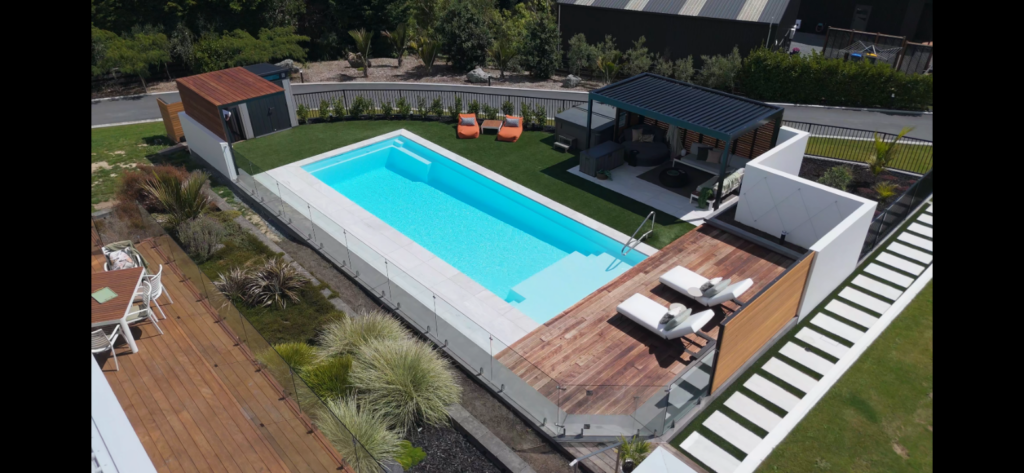
A fibreglass pool is a factory-manufactured shell, moulded from fibreglass-reinforced plastic and finished with a gelcoat interior. The shell is made in a single piece, delivered to site, and installed into a prepared excavation, typically within one week. The gelcoat surface is non-porous, smooth, and colour-integral, meaning the colour runs through the coating rather than sitting on top.
Inground fibreglass pools come in a wide range of shapes, sizes, and depths, from compact plunge pools to full family-size models with ledge seating and shallow entry areas.
This is the comparison most New Zealand homeowners need, so here it is side by side.
| Fibreglass | Concrete | |
| Installation time | 1 week | 3–6 months |
| Surface | Smooth, non-porous gelcoat | Rough, porous plaster or aggregate |
| Chemical use | Lower (algae struggles to take hold) | Higher (porous surface harbours algae) |
| Annual maintenance cost | Lower | Higher |
| Resurfacing | Not required in normal lifespan | Every 10–15 years ($15,000–$30,000+) |
| Flexibility (ground movement) | Flexes without cracking | Can crack with soil movement |
| Custom shape options | Manufacturer range | Fully custom |
| Lifespan | 25+ years | 25+ years (with maintenance) |
| UV performance | Gelcoat colour holds well | Surface degrades and fades |
Concrete pools offer one genuine advantage: complete customisation. If you need an unusual shape or a very large pool that doesn't fit any standard mould, concrete gives you that freedom. For most New Zealand homeowners, though, the available fibreglass range covers every practical need and the ongoing savings are significant.
One of the most underestimated differences between fibreglass and concrete pools is time.
A fibreglass shell is manufactured to specification in a controlled factory environment. When it arrives on site, the excavation is prepared, the shell is craned in, connections are made, and the pool is filled. Most installations are complete in one to three weeks.
Concrete is built on-site. The process involves excavation, steel reinforcing, spraying or pouring concrete, curing time, plastering, and finishing. From start to swim, you're typically looking at three to six months.
That time difference matters practically. It means less disruption to your backyard, fewer weeks of access restrictions, and a faster path to actually using what you've paid for. For families who start planning in autumn with summer in mind, it can mean the difference between swimming and waiting another year.
The non-porous surface of a fibreglass pool is the key to lower running costs. Algae needs something to grip onto. On a smooth gelcoat interior, it struggles. On a porous concrete surface, it finds plenty of places to grow.
The result is a meaningful difference in what you spend on chemicals each year. Fibreglass pool owners typically use 70% less chlorine than concrete pool owners. Over a ten-year period, that adds up to thousands of dollars.
The bigger saving comes from what fibreglass doesn't need. Concrete pools require resurfacing every ten to fifteen years. In New Zealand, that work typically costs between $15,000 and $30,000 depending on the pool size and the finish chosen. It's a significant cost that fibreglass owners don't face.
Low maintenance pools in New Zealand also need to account for UV exposure. New Zealand has some of the highest UV levels in the world, and that affects pool surfaces. Concrete plaster and aggregate finishes fade and degrade under sustained UV. Fibreglass gelcoat holds its colour better over time because the colour is part of the coating itself, not a layer applied on top.
Durable swimming pools for New Zealand need to handle more than UV. Ground movement is a real consideration, particularly in Wellington and other areas of seismic activity.
Concrete is a rigid material. When soil shifts, a concrete pool can crack. Fibreglass is flexible by nature. The material can accommodate minor ground movement without structural damage, which makes it a particularly good fit for Wellington sections where the ground has some give.
The fibreglass shell also doesn't corrode. There are no steel reinforcing elements close to the pool surface, so you don't get the rust staining that can affect concrete pools over time.
When it comes to durability, fibreglass doesn't ask much. A regular water balance, occasional brushing, and an annual check of your filtration system covers most of what the pool needs. There's no plastering to inspect, no surface to reseal, and no concern about the interior breaking down as the years go by.
The range of inground fibreglass pools available in New Zealand has expanded considerably in recent years. The idea that you're limited to a basic rectangle is well out of date.
NZ Pools stocks the Leisure Pools Australia range, which includes models from compact entry-level designs through to large family pools with multiple features. Current models span eleven styles, including the Reflection, Elegance, Absolute, Acclaim, Harmony, Esprit, Olympus, Capri, Fiji Plunge, and the Reflection variants with Auto Cover or Splash Deck. All models are available across a wide range of sizes and in eight interior colours: Sapphire Blue, Crystal Blue, Diamond Sand, Aquamarine, Shimmer White, Graphite Grey, Silver Grey, and Ebony Blue.
Key features available across the range include:
Every pool in the range is manufactured to Australian and New Zealand standards. NZ Pools handles the full process from initial consultation through to installation and aftercare, so you're not managing multiple contractors across a six-month build.
The upfront cost of a fibreglass pool is generally comparable to a concrete pool of similar size. Where fibreglass pulls ahead is in total cost of ownership.
Add up the chemical savings over ten years. Add the cost of a concrete resurface you'll never need. Factor in the time cost of higher maintenance. The picture becomes clear: fibreglass is the more cost-effective choice for most New Zealand homeowners over any reasonable timeframe.
This is why fibreglass swimming pools in New Zealand have grown in popularity even as the overall pool market has become more competitive. Homeowners who've done the maths choose fibreglass not because it's cheaper to buy, but because it's cheaper to own.
If you're serious about understanding the numbers for your specific situation, a conversation with the NZ Pools team is the fastest way to get there. They can walk you through what your ongoing running costs are likely to look like based on pool size, your location, and how often you plan to use it.
Request a free quote from NZ Pools
Wellington has particular reasons to favour fibreglass.
The city's weather is more variable than Auckland or Nelson, but Wellington summers are genuinely warm, and a heated fibreglass pool extends the usable season from October through to April. The shorter installation window matters when weather windows are narrower.
Wellington sections often sit on ground with some movement. The flexibility of fibreglass is an asset here, where rigid concrete would carry more risk.
And Wellington's strong UV exposure during summer months makes the UV-resistance of fibreglass gelcoat a practical benefit, not just a marketing point.
NZ Pools is the only SPASA Gold Award-winning pool installer in Wellington (Fibreglass Pool up to $80,000, 2024). The team has been installing pools across Wellington and Wairarapa for years, and their knowledge of local sections, local councils, and local conditions is part of what makes the process straightforward.
Are fibreglass pools better than concrete pools? For most New Zealand homeowners, yes. Fibreglass pools install faster, cost less to maintain, don't require resurfacing, and are more resistant to cracking from ground movement. Concrete pools offer more shape flexibility, but the practical advantages of fibreglass outweigh this for the majority of residential installations.
How long do fibreglass pools last in New Zealand? A well-maintained fibreglass pool can last 25 years or more. The gelcoat surface is durable and UV-resistant, and the shell itself is not subject to corrosion. The key is maintaining good water chemistry, which protects both the shell and the pool equipment.
What is the maintenance cost of a fibreglass pool in NZ? Fibreglass pools use significantly fewer chemicals than concrete pools, typically around 70% less chlorine. Combined with no resurfacing requirements, annual maintenance costs are considerably lower. Exact costs depend on pool size, usage, and your chosen maintenance approach (self-managed vs professional servicing).
How long does it take to install a fibreglass pool? Most fibreglass pool installations take one to three weeks from excavation to fill. This compares favourably to concrete pools, which typically take three to six months to build on-site.
Can fibreglass pools crack? Fibreglass is a flexible material that can accommodate minor ground movement without cracking. This makes it particularly suited to areas with some seismic activity, such as Wellington. Concrete pools, being rigid, carry a higher risk of cracking when soil shifts.
What colours are available for fibreglass pools in NZ? The Leisure Pools range available through NZ Pools comes in four interior colours: Graphite Grey, Shimmer White, Sapphire Blue, and Ebony Blue. The colour is part of the gelcoat itself, so it holds well over time without fading.
If you're weighing up your options, the best next step is a conversation with someone who knows Wellington sections, local councils, and the full range of available pools.
The NZ Pools team offers free consultations with no obligation. They'll help you understand what pool would suit your section, what the installation process involves, and what your ongoing running costs are likely to look like.
Browse the pool range at nzpools.co.nz and get in touch to request your free quote.
If you've started researching swimming pools for your home, you've probably noticed there's no shortage of pool builders in Wellington. Quotes vary. Claims vary. And it can be genuinely hard to know who to trust with a project this significant.
So rather than tell you we're the best option and leave it at that, we want to walk you through exactly what makes NZ Pools different. Not in a vague, everyone-says-this way. In a specific, here's-the-evidence way.
The SPASA Awards (Swimming Pool & Spa Association of Australasia) are the industry's most recognised benchmark for quality. Judges assess completed pool projects on design, installation quality, site complexity, finish, and craftsmanship.
In 2024, NZ Pools won the SPASA Gold Award in the Fibreglass Pool up to $80,000 category. We also received Highly Commended recognition across three additional categories:
These aren't marketing claims. They're independent industry judgements made by qualified assessors who've seen thousands of pools across New Zealand and Australia.
When you're choosing between pool installers in Wellington, awards like these matter. They tell you that a third party has assessed the work and found it exceptional.
Some pool companies operate as franchises. You sign a contract with a Wellington rep, but installation crews, product decisions, and processes are all managed from somewhere else. When something goes wrong, accountability can be hard to pin down.
NZ Pools is different. Brent and the team are based here in Wellington and Wairarapa. They know the local terrain, the council requirements, the soil conditions, and the weather patterns that affect pool construction in this region. That local knowledge matters more than most people realise when it comes to installation timelines, site preparation, and getting the result right.
You're not dealing with a call centre. You're dealing with the people who will actually build your pool.
The single biggest fear most homeowners have when taking on a project like this is the unexpected. Unexpected costs. Unexpected delays. Unexpected complications mid-dig.
It's the thing we hear about most from customers who came to us after bad experiences with other contractors. And it's why we've built our entire process around removing that fear.
From your first consultation, we walk you through every stage of the installation. What happens on day one. What happens on day five. What could cause a delay, and how we handle it if it does. What's included, what isn't, and what everything costs.
Our customers describe this as "no unexpected surprises" and "explained the installation process well upfront." That's not luck. That's how we operate.
Not all fibreglass pools are the same. The quality of the shell, the gelcoat, the structural integrity, and the finish vary enormously between manufacturers.
NZ Pools stocks the Leisure Pools Australia range, one of the most respected fibreglass pool ranges in the Southern Hemisphere. Leisure Pools are engineered with Composite Armour Technology, offering superior UV resistance, non-porous surfaces, and long-term structural strength.
Our current range includes four models across a variety of sizes and colours:
Available in Sapphire Blue, Crystal Blue, Diamond Sand, Aquamarine, Shimmer White, Graphite Grey, Silver Grey, Ebony Blue.
Some builders in Wellington offer pool construction as one of many services. It sits alongside landscaping, decking, and renovation work. For them, a pool is a project type. For us, it's everything.
Being a dedicated pool specialist in Wellington means our knowledge, relationships, and processes are entirely focused on delivering great fibreglass pool installations. We know the products deeply. We know the installation process deeply. And when something unusual comes up during construction, we've almost certainly dealt with it before.
That depth of experience is hard to replicate.
Many pool companies disappear once the final payment clears. Installation done, job finished, best of luck with the chemistry.
NZ Pools takes a different view. Our relationship with customers continues long after the pool is full of water and the family is swimming in it.
We provide hands-on guidance on water care, maintenance routines, and how to get the most from your pool year-round. Our customers regularly mention this in reviews. One noted that Brent and the team provided "ongoing advice and service long after the project was completed." Another described the team's "tireless commitment to keeping promises."
That kind of ongoing support isn't something you can put a price on. But it's part of why our customers consistently recommend us to friends and family across Wellington and Wairarapa.
Awards and credentials matter. But so does what real homeowners say after the project is done.
Here's how Wellington families describe their experience with NZ Pools:
These aren't cherry-picked. They reflect the feedback we consistently receive on Google. We'd encourage anyone researching pool construction in Wellington to read through those reviews in full.
| NZ Pools | Generic pool builder | |
| SPASA Gold Award winner | Yes | Rarely |
| Wellington-based local team | Yes | Often franchise-operated |
| Dedicated pool specialists | Yes | Often multi-trade |
| Leisure Pools Australia range | Yes | No |
| Transparent, no-surprises process | Yes | Not always |
| Ongoing aftercare and support | Yes | Limited |
Choosing the right pool builder is one of the most important decisions in the whole project. The pool itself will be in your backyard for 20 to 30 years. The experience of getting there should be stress-free.
If you're at the early stages of exploring your options, the best place to start is browsing our pool range at nzpools.co.nz. You'll get a clear sense of the models, sizes, and colours available, along with more detail on our process.
When you're ready to talk, we're happy to come out and assess your section, answer your questions, and give you a clear, honest quote. No pressure. No surprises.
What makes NZ Pools different from other pool builders in Wellington? NZ Pools is the only fibreglass pool installer in Wellington to have won a SPASA Gold Award (2024). We're a local team, not a franchise, and we're dedicated pool specialists rather than generalists. Our process is built around transparency and we provide ongoing aftercare long after installation is complete.
What types of fibreglass pools does NZ Pools install? We stock the Leisure Pools Australia range, which includes a number of different models. To view our full range click here.
Does NZ Pools service Wellington and Wairarapa? Yes. NZ Pools operates across the Wellington region and Wairarapa. As a locally based team, we have specific knowledge of local site conditions, council requirements, and construction considerations in this area.
How long does fibreglass pool installation take in Wellington? Installation timelines vary depending on site conditions, council consent requirements, and the time of year. We walk every customer through realistic timelines during the consultation process so you know exactly what to expect.
What awards has NZ Pools won? NZ Pools won the SPASA Gold Award in 2024 for Fibreglass Pool up to $80,000. We also received Highly Commended in three additional categories: Fibreglass Pool & Spa Combo, Courtyard/Small Pool up to $80,000, and Fibreglass Pool up to $120,000.
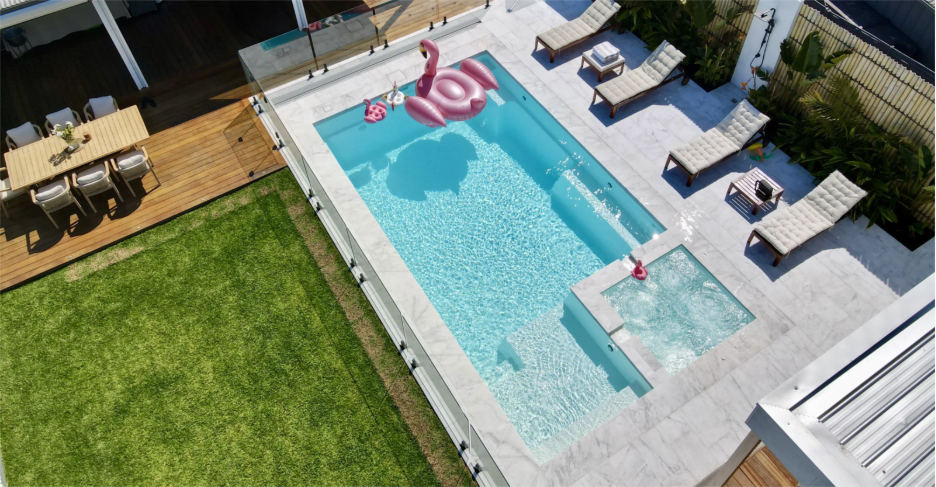
So you've decided you want a pool. The kids are begging for it, summer is coming, and the backyard is sitting there doing nothing. But before you commit to anything, you want to understand exactly what the installation process looks like: what happens, how long it takes, and who needs to be involved.
Good thinking. A fibreglass pool is a significant investment, and the more you understand the process upfront, the smoother the experience will be.
This guide walks you through every stage of fibreglass pool installation in New Zealand, from your first conversation with an installer through to your first swim.
Before we get into the installation steps, it helps to understand why fibreglass has become the go-to option for New Zealand homeowners.
Compared to concrete, fibreglass pools install faster, cost less over time, and require far less maintenance. The smooth gelcoat surface resists algae growth, meaning fewer chemicals and less scrubbing. Compared to above-ground pools, they look better, last longer, and add genuine value to your property.
For families in Wellington and Wairarapa especially, where outdoor living season can be shorter, a low-maintenance pool that's quick to get up and running just makes sense.
The Full Fibreglass Pool Installation Process
Every pool project starts with a conversation. A reputable installer will visit your property to assess:
This is also when you'll discuss pool models, sizes, and colours. At NZ Pools, we stock the Leisure Pools Australia range, which includes models like the Reflection, Elegance, Absolute, and Acclaim in sizes and colours suited to New Zealand backyards.
The consultation is your chance to ask every question you have, there are no dumb questions.
Once the site assessment is done, your installer will put together a detailed quote covering the pool supply, excavation, installation, plumbing, electrical, and any additional work like fencing, decking, or landscaping.
In New Zealand, inground swimming pools typically require a building consent from your local council. Your pool installer should guide you through this process, or handle it on your behalf. In Wellington and Wairarapa, this means working with Wellington City Council, Porirua City Council, Upper Hutt City Council, Lower Hutt City Council, or Masterton District Council depending on your location.
Timeframes for consent approval vary, but your installer should build this into the project timeline from the start. Rushing consent is a red flag.
What to look for: A good installer won't start digging until consent is approved. Anyone who suggests you can deal with consent "later" is not someone you want managing your project.
Once consent is granted and a start date is confirmed, excavation begins. This is when the project becomes real.
A digger is brought in to excavate the pool shell cavity to the correct depth and shape. The hole is dug slightly larger than the pool shell to allow for backfill and to make positioning easier.
Excavation typically takes one to two days for a standard residential pool, depending on soil conditions and site access. Rocky ground, clay soils, or tight access points can extend this phase.
The excavated soil is removed from site. Your yard will look like a construction site at this stage, which is completely normal.
The fibreglass shell is manufactured off-site and delivered to your property on a truck. Depending on your section's access, it will either be lifted into position using a crane or manoeuvred into place via the delivery vehicle.
This is one of the most dramatic moments of the project. Watching a large pool shell being lowered into the ground is something homeowners remember. It also tends to attract interested neighbours.
The shell is positioned carefully in the excavated cavity and levelled to ensure even water distribution once filled.
With the shell in the ground, we connect the pipework for the filtration system, including the skimmer box, main drain, return jets, and any additional features like water features, lights, or heating connections.
As plumbing progresses, the cavity around the shell is backfilled with a sand and gravel mix (or in some cases, concrete) to secure the shell in position and prevent movement. This process happens in stages, with the pool being partially filled with water simultaneously to balance the pressure inside and outside the shell.
Getting this stage right is critical. Poor backfilling leads to cracking or shell movement over time. This is not the stage to cut corners.
The pool equipment (pump, filter, salt chlorinator or chemical dosing system, and any automation) is installed in a designated equipment area, usually beside the pool or in a concealed cabinet..
If you've opted for LED lighting, heating (heat pump or solar), or a smart automation system, these are all connected and tested during this phase.
The bond beam (concrete skirt) around the pool is formed and poured. This creates a finished edge between the pool shell and whatever surrounding surface you've chosen: concrete, pavers, timber decking, or artificial grass. Your copings will be laid onto the top of the bond beam and then the rest of your hard landscaping will be laid after that.
This phase also includes any steps, built-in seating, or feature walls you've agreed on in the design stage. The pool surround makes a significant difference to the final look of your outdoor area, so it's worth putting thought into the finish early.
In New Zealand, inground pools must be enclosed by a compliant safety fence under the Fencing of Swimming Pools Act 1987 (now incorporated into the Building Act). The fence must meet specific height and gate requirements, and your local council will inspect it as part of the consent sign-off.
Pool installers may co-ordinate the fencing contractor, but confirm this during the quoting stage. Pool fencing is not optional, and non-compliance is a legal liability.
At the end of the project, the pool fencing is inspected by your local council as part of the building consent close-out process. Once the inspector is satisfied, the code of compliance certificate is issued.
Your installer will also do a full handover with you, covering:
A quality installer doesn't disappear after handover. Look for someone who offers ongoing support and is happy to answer questions months after installation.
The pool is filled (usually with a hose, and it can take 24 to 48 hours), water chemistry is balanced, and the filtration system is commissioned.
Once everything checks out, it's time to swim.
For a new fibreglass pool, the first few weeks involve more frequent testing as the water chemistry stabilises. Your installer should walk you through this, or recommend a local pool shop that can test and advise.
From signed contract to first swim, a typical fibreglass pool installation takes 6 to 12 weeks, depending on:
The physical installation (from excavation to handover) typically takes 2 to 4 weeks once consent is granted and materials are on hand.
Not all installers are equal. Here's what separates good from great:
Transparency about costs. Your quote should be detailed and fixed-price where possible. "We'll sort that out later" is not acceptable on a project of this size.
Experience with local councils. Wellington and Wairarapa councils each have their own quirks and timelines. A local installer who has done this hundreds of times will navigate consent faster and with fewer surprises.
Industry recognition. SPASA (Swimming Pool and Spa Association) awards are the industry benchmark. NZ Pools is a SPASA Gold Award winner for 2024 and 2025, an independent assessment of installation quality that you can trust.
Aftercare. The relationship doesn't end at handover. Ask installers how they handle issues that come up post-installation. Read their Google reviews specifically for post-installation support.
References. Ask to speak with past customers in your region. Any confident installer will be happy to provide them.
Do I need council consent for a pool in Wellington?
Yes. Inground pools require building consent in Wellington and across Wairarapa. Your installer should manage this process for you.
How deep can a fibreglass pool be installed on a sloped section?
Most sections in Wellington are not flat. Experienced installers work with sloped sites regularly and can use retaining walls, raised surrounds, or split-level designs to make a pool work on your section.
Will a pool add value to my property in Wellington?
Generally yes, particularly in family-oriented suburbs. A well-installed pool with quality fencing and landscaping is considered a genuine value-add.
What's the difference between fibreglass and concrete pools?
Fibreglass pools install faster, cost less to maintain, and the shell doesn't require resurfacing. Concrete pools offer more flexibility in shape but take longer to build, cost more upfront, and require regular acid washing and resurfacing over their lifespan.
If you're thinking about a fibreglass pool in Wellington or Wairarapa, the best first step is a no-obligation site visit and quote. You'll get a realistic picture of what's possible on your section, what it will cost, and what the timeline looks like.
NZ Pools handles the full process, from design and council consent through to installation, and handover. Our team has installed pools across Wellington and Wairarapa for years, and we're proud of our reputation for transparent communication and ongoing support.
Request a Quote Or browse our pool range to find the model and size that suits your backyard: View Pool Range
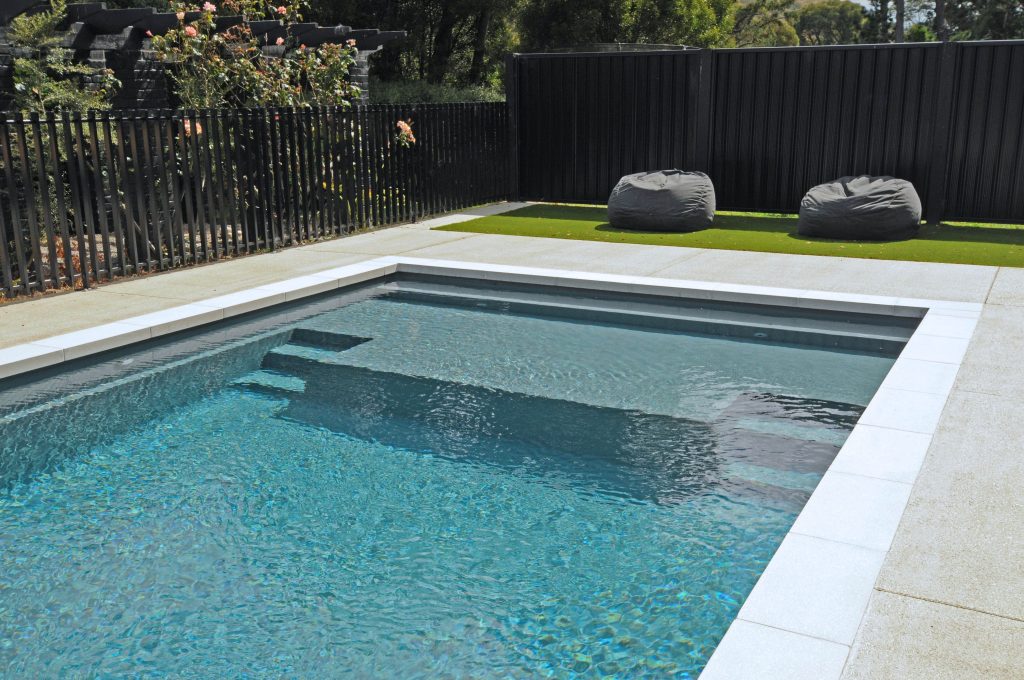
There's a moment in every Wellington summer that makes pool-owning families quietly smug. The kids are in the water, the adults have their feet in the shallow end, someone's handed you a cold drink, and the backyard looks like something out of a magazine. That moment? A splash deck pool makes it happen more often.
If you've been researching family-friendly pool designs and keep landing on photos of sleek pools with wide, shallow entry areas, you've already spotted the splash deck trend. It's one of the fastest-growing modern pool features in New Zealand, and once you understand what makes them so practical for Kiwi families, it's not hard to see why.
Here are five reasons a splash deck pool might be exactly what your backyard needs.
Every parent knows the mental load of watching kids near deep water. A splash deck changes that dynamic completely.
A splash deck is a flat, shallow entry zone, usually 600mm deep, that extends into the pool before dropping into the main swimming area. Think of it like a beach entry: the water gets progressively deeper as you walk in, rather than stepping down from a vertical edge.
For toddlers and young children, this is a genuine game-changer. They can splash, play, and cool off in water that barely reaches their knees, while parents relax nearby rather than hovering at the edge. It's the kind of feature that makes a pool genuinely usable from the moment kids are old enough to toddle outside.
As a kids splash pool option, it's hard to beat. And for families with children of different ages, the shallow zone gives younger ones their own space while older kids and adults use the deeper end.
One of the most common things we hear from Wellington families is that they want a pool the whole family will use, not just the teenagers who want to do laps. A splash deck pool delivers that.
Adults who don't love jumping into deep water straight away appreciate the gradual entry. Grandparents who are nervous about steps into a pool find a shallow entry much more comfortable. Even guests who aren't strong swimmers feel at ease. The shallow area becomes a natural gathering spot for people who want to be in the water without fully submerging.
This makes the pool a genuinely social space. Families use their pools more when more family members feel comfortable in them. That might sound obvious, but it's worth saying: the best pool is one that actually gets used.
Let's be honest, part of choosing a pool is about how the backyard looks. A splash deck pool has a naturally elegant, resort-style appearance that photographs beautifully and impresses guests.
The wide, shallow entry creates a visual transition between the poolside paving and the water. When combined with quality coping, landscaping, and one of the premium colour options available through the Leisure Pools range (think Graphite Grey, Shimmer White, or Sapphire Blue), the result is a backyard that looks considered and cohesive rather than like a hole with a liner dropped in.
For Wellington homeowners who want to add genuine value to their property, this aesthetic quality matters. A pool that looks like a feature, rather than an afterthought, reflects well on the home overall.
Modern pool features like splash decks sit naturally alongside deck jets, LED lighting, and tanning ledges. If you're building a pool that will define your outdoor space for the next 20 years, the visual impact of the design deserves real thought.
New Zealand sections, especially in Wellington and the Wairarapa, are often not vast. One concern families have is whether a pool will eat up all their usable outdoor space.
A splash deck pool works well on smaller sections because the shallow entry zone doubles as usable outdoor space. On warm days, you can set up chairs directly in the shallow water, turning that space into a wading area. It's functional square metreage, not dead space around a pool edge.
Wellington's climate is also worth considering. The region gets wind, and not every summer day calls for full immersion. A shallow splash zone means families can still get into the water on cooler or windier days when jumping into a cold deep end would be uninviting. Kids can play in the shallows, get wet, and enjoy the pool even on days that don't feel like full swimming weather.
For pools Wellington New Zealand, this kind of year-round usability genuinely matters.
Splash decks and fibreglass pools are a natural match. Because fibreglass pools are manufactured as a single shell, the splash deck entry zone is moulded directly into the design. There are no extra construction steps, no poured-concrete transitions to worry about, and no surfaces that are harder to maintain than the rest of the shell.
The smooth gelcoat surface of a fibreglass pool extends through the splash deck area, which means it's easy to clean, algae-resistant, and comfortable underfoot. Compared to tiled or concrete shallow areas, fibreglass is gentler on feet and knees, which matters when kids are spending hours in that zone.
At NZ Pools, several models in the Leisure Pools range include splash deck configurations. The Acclaim or Reflection with Splash Deck models, for example, are popular choices for families who want that resort-style entry combined with a practical, durable pool shell that will last for decades.
Space requirements: Splash decks do extend the overall footprint of the pool. If your section is tight, talk through the dimensions carefully with your installer to make sure the pool fits well and still leaves room for decking or landscaping.
Fencing and compliance: All inground pools in New Zealand require compliant fencing under the Fencing of Swimming Pools Act 1987. Your pool installer will walk you through what's required, but it's worth factoring fencing into your early planning and budget.
Complementary features: Splash decks pair well with in-pool seating ledges, deck jets (arching water jets that are popular with younger kids), and bubbler features in the shallow zone. If you're designing your pool from scratch, it's worth considering the full picture.
A splash deck pool is one of those design decisions that families consistently say they'd make again. The combination of safety, practicality, visual appeal, and year-round usability makes it one of the most sensible modern pool features available for New Zealand family backyards.
At NZ Pools, we're Wellington and Wairarapa's SPASA Gold Award-winning fibreglass pool installers. We work with families at every stage, from the first conversation about what's possible on your section, through to installation and aftercare. No unexpected surprises, just a straightforward process and a pool your family will love for years.
Browse our pool range or request a quote to start the conversation.
What is a splash deck pool? A splash deck pool features a wide, gently sloping shallow entry zone, usually 600mm deep, that transitions gradually into the main swimming area. The design mimics a natural beach entry and is popular for families with young children.
Are splash deck pools safe for toddlers? Yes. The shallow entry zone is specifically suited to young children, as the water depth is minimal. Adult supervision is still required around any pool, but the shallow zone significantly reduces the risks associated with deep water entry points.
What depth is a splash deck? Splash decks are typically 600mm deep, which is usually between 1.2m and 1.8m for a standard family pool.
Do splash deck pools cost more? In fibreglass pools, the splash deck is moulded into the shell, so there is no significant cost premium for the feature itself. The overall pool price will depend on the model, size, and installation requirements for your specific section.
Can I add a splash deck to an existing pool? In most cases, no. Splash decks are a structural feature of the pool shell and are not easily added to an existing pool. They are best planned from the outset when choosing your pool design.
A pool is one of the biggest investments you'll make for your home. So before you sign anything, you need to know exactly what's covered if something goes wrong.
Pool warranties in New Zealand vary wildly. Some manufacturers offer seven years. Others promise a "lifetime." But what does that actually mean, and what should you look out for?
Here's a plain-English breakdown of fibreglass pool warranties in NZ, what they cover, and the questions you should be asking before you commit.
Most fibreglass pool warranties in New Zealand cover two things:
This covers the physical integrity of the pool shell. If the shell cracks, deforms, or fails under normal use, the manufacturer will repair or replace it. This is your most important warranty.
Osmosis is the enemy of fibreglass pools. It happens when water seeps through the gel coat and into the fibreglass layers underneath. Over time, this causes bubbles, blisters, or bulges on the pool surface.
Left untreated, osmosis weakens the shell and ruins the finish. Repairing it means draining the pool, grinding back the affected area, and re-coating. It's not cheap.
Here's what most homeowners don't realise: osmosis warranties are rare in New Zealand. Most fibreglass pool manufacturers don't offer one at all. Their structural warranty covers cracks and defects, but if osmosis appears — which is one of the most common issues with fibreglass pools — you're on your own.
A manufacturer that includes a dedicated osmosis warranty is telling you two things: their resin and manufacturing process are good enough that osmosis shouldn't happen, and if it does, they'll stand behind it. That's a very different level of confidence from a manufacturer that quietly excludes osmosis from their coverage.
When you're comparing pool quotes, check whether osmosis is explicitly covered. If it's not mentioned, assume it's not included.
In New Zealand, all residential pool installations are covered by the Building Act 2004, which provides an implied 10-year warranty for structural integrity. While this is a good baseline, a premium pool should be built to last much longer than a decade.
| Warranty Type | Budget Fibreglass | Mid-Range | Premium (e.g. Leisure Pools) |
| Structural | 7 - 10 years | 15 - 25 years | Lifetime (35 years) |
| Osmosis | Usually not offered | Rarely offered | Lifetime (35 years) |
| Surface/Gel Coat | 1 - 5 years | 5 - 10 years | Varies |
Seven years might sound decent until you remember that your pool should last decades. A short warranty often signals cheaper materials and a less durable shell.
What "lifetime" actually means: In the New Zealand pool industry, a "Lifetime" warranty is officially defined as 35 years. This provides coverage far beyond the minimum requirements of the Building Act, offering true long-term peace of mind.
The single biggest factor in fibreglass pool durability is the resin and reinforcement used during manufacturing.
Ask your pool builder: Is the shell made with full vinyl ester resin, or just a single "barrier coat" over cheaper polyester layers?
Yes, but there are specific "windows" you need to be aware of. A transferable warranty is a major selling point in the NZ property market, but it requires prompt action.
Under the Leisure Pools warranty, the following conditions apply:
Most pool warranties come with conditions. Common exclusions include:
The bottom line: Register your warranty on time, maintain your water chemistry, and keep your pool builder's documentation.
Before you commit to a fibreglass pool, put these questions to your builder:
A reputable pool builder will answer these questions without hesitation. If they're vague or defensive, that tells you something.
It's tempting to go with the cheapest quote. But a pool that costs $10,000 less upfront could cost you $15,000 in repairs if osmosis appears at year eight and your warranty only covered seven.
A strong warranty, backed by quality materials and a manufacturer who has been around long enough to honour it, is one of the best forms of insurance you can get on a major home improvement.
When you're comparing pool quotes, don't just compare the bottom line. Compare what happens if something goes wrong.
We are proud to be 2024 SPASA Gold Winners (New Zealand) in the Fibreglass Pool up to $80,000 category for our Martinborough Retreat project. This award recognizes our commitment to technical excellence and high-quality finishes.
As authorised Leisure Pools builders, every pool we install comes with a 35-year (Lifetime) structural and osmosis warranty, backed by full vinyl ester resin and Composite Armour™ construction. We’ll walk you through the fine print—no surprises, just a pool built to last a generation.
Talk to us about your pool project →
NZ Pools is a locally owned family business serving Kapiti, Wellington, and Wairarapa. Over 35 years of building experience. SPASA Gold Award winners.
A backyard pool is more than just a place to cool off, it’s the heart of family fun, relaxation, and connection. For families with young children, creating a pool that’s both safe and enjoyable is essential. One design feature that perfectly blends functionality with fun is the splash deck.
Also known as a tanning ledge, wet deck, or baja shelf, a splash deck provides a shallow, flat area in your pool where the water level is just deep enough for lounging, playing, or supervising kids. It’s one of the most requested features in family pool designs across New Zealand, and for good reason.
In this guide, we’ll explore the benefits of splash decks, how to incorporate one into your pool design, what to consider during installation, and how trusted professionals like NZ Pools can help you bring your family’s dream pool to life.
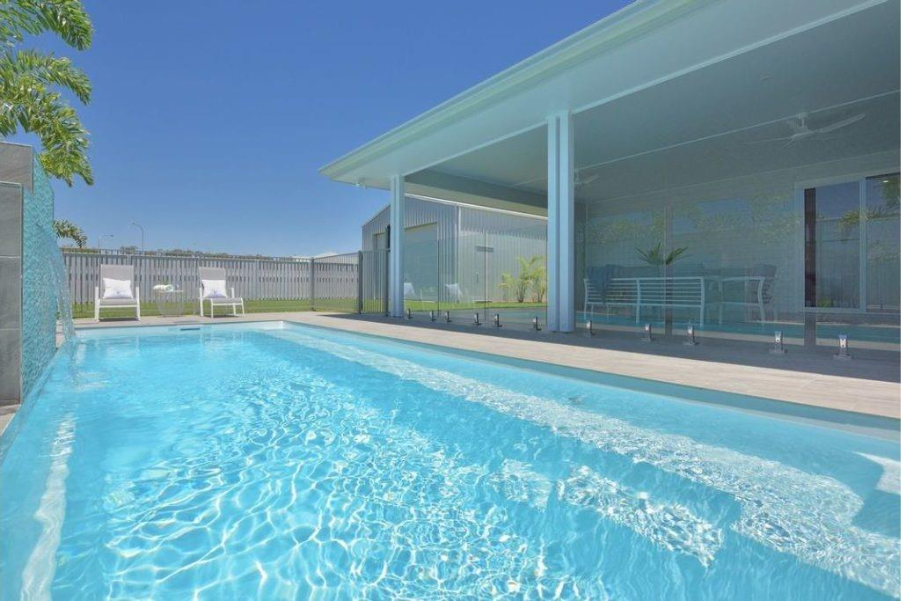
What Is a Splash Deck?
A splash deck is a shallow platform that extends into your pool, usually ranging from a few centimetres to about 60 cm deep. It’s ideal for toddlers, pets, or adults who want to cool off without fully submerging.
Think of it as a smooth transition zone between your pool’s edge and deeper water. This versatile space can include built-in loungers, water bubblers, or even umbrella mounts, turning your pool into a luxurious and family-friendly retreat.
The Benefits of a Splash Deck for Families
Incorporating a splash deck into your pool design offers both practical and aesthetic advantages.
1. Safety for Kids
Safety is the number one concern for families with children. A splash deck creates a shallow play area where kids can enjoy the water safely under adult supervision. It gives them confidence in the pool while allowing parents peace of mind.
2. Multi-Functional Relaxation Space
While children play, parents can unwind on the splash deck’s submerged loungers or chairs. It’s a perfect spot for sunbathing, reading, or socialising while staying cool in the water.
3. Perfect for Pets and Elderly Family Members
Splash decks aren’t just for kids, they’re also excellent for pets or older family members who prefer shallower water. It’s a gentle, accessible area that accommodates everyone.
4. Adds Property Value
Pools with modern features like splash decks are highly desirable for families in New Zealand’s property market. A thoughtfully designed splash deck can boost your home’s resale value while offering years of enjoyment.
Designing the Perfect Splash Deck
When incorporating a splash deck into your pool, design and placement matter. The team at NZ Pools recommends considering your family’s lifestyle, pool size, and surrounding landscape before finalising the layout.
Here are some key design considerations:
Size and Depth
The ideal depth for a splash deck is between 30 - 60 cm. This provides enough water for cooling off but remains safe for children. The size depends on your available space and how you intend to use it, whether for sun loungers, play, or wading.
Materials and Finish
Choosing durable, slip-resistant materials ensures comfort and safety.
Installation: What to Expect
Building a splash deck requires precise planning and professional installation. It’s best handled by experienced pool builders who understand both the technical and aesthetic aspects of design.
When you work with experts like NZ Pools, the process typically includes:
Once completed, your splash deck will become one of the most versatile and enjoyable areas of your outdoor space.
Why Choose NZ Pools for Your Family Pool Project
NZ Pools is a trusted name in New Zealand pool design and construction, known for delivering stunning, functional, and family-friendly pools. Their team specializes in custom designs that cater to different lifestyles and budgets, ensuring every pool is both safe and stylish.
From concept to completion, NZ Pools focuses on:
When it comes to creating a family-friendly oasis, NZ Pools brings the perfect balance of innovation, safety, and beauty to every project.
Conclusion
A splash deck is more than a design feature, it’s a family-friendly addition that transforms your pool into a safe, stylish, and versatile retreat. Whether you want a shallow play area for the kids, a relaxing space to lounge in the sun, or a luxurious aesthetic upgrade, a splash deck delivers it all.
By partnering with professionals like NZ Pools, you can ensure your pool is expertly designed and built to enhance your lifestyle. Ready to start your dream pool project? Visit the NZ Pools contact page to book a consultation today.
FAQs
1. What is the ideal depth for a splash deck?
Most splash decks range between 30 - 60 cm deep, providing just enough water for children to play safely or adults to relax comfortably.
2. Can I add a splash deck to my existing pool?
In many cases, yes. It depends on your pool’s structure and available space. A professional assessment from NZ Pools can determine the best approach.
3. Is a splash deck safe for young children?
Absolutely. With shallow water and non-slip finishes, a splash deck offers a safe and controlled play environment when supervised by adults.
4. How much does a splash deck cost to install?
The cost varies depending on design, materials, and additional features.
5. Do splash decks require special maintenance?
Not particularly. They require the same care as the rest of your pool, regular cleaning, proper filtration, and periodic inspections.